Readings
Play Time
Kate Lilley
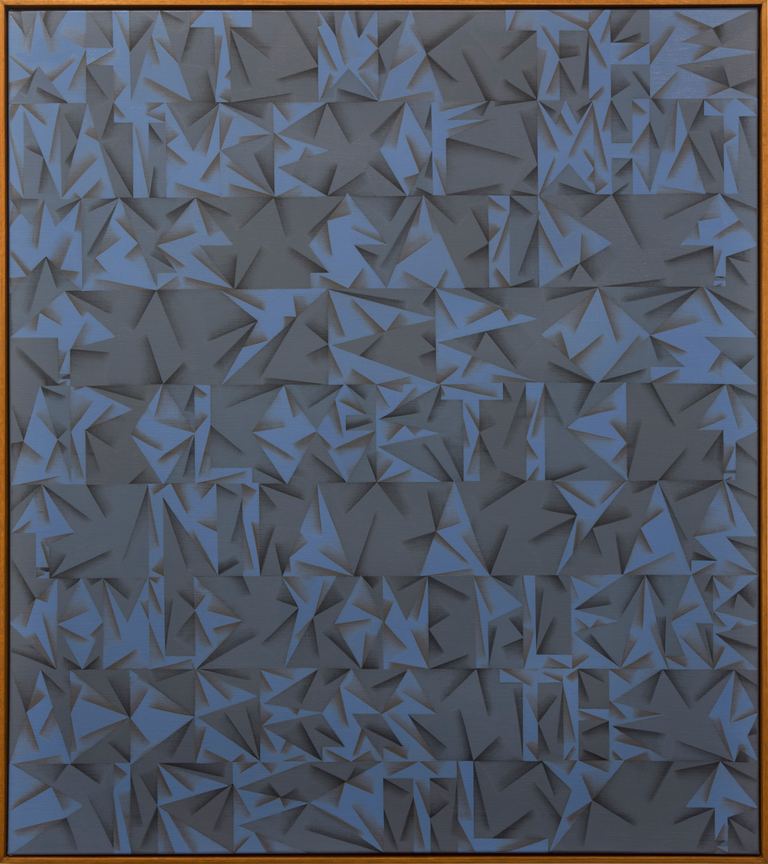
In all the modes of Mitch Cairns’s various practices, language features prominently and exuberantly as essential material and orientation. Cairns’s turn to language is full of charm and wit. Word play and letter play, both graphic and semantic, produce a sense of buoyant plasticity. His diverse verbico-visual experiments are generative engines of surprise and pleasure. Drawing on lettrist, conceptual, and concrete poetics, they pursue the work of serious play through formal ingenuity and skill, wit and charm, delighting and instructing with a light touch and immaculate hand. In oil paintings, Letraset collages, and cast-bronze plaques, language adheres and inheres; the most refined materials and methods cross-fertilised with the overlooked stuff of everyday life (coasters, invoices).
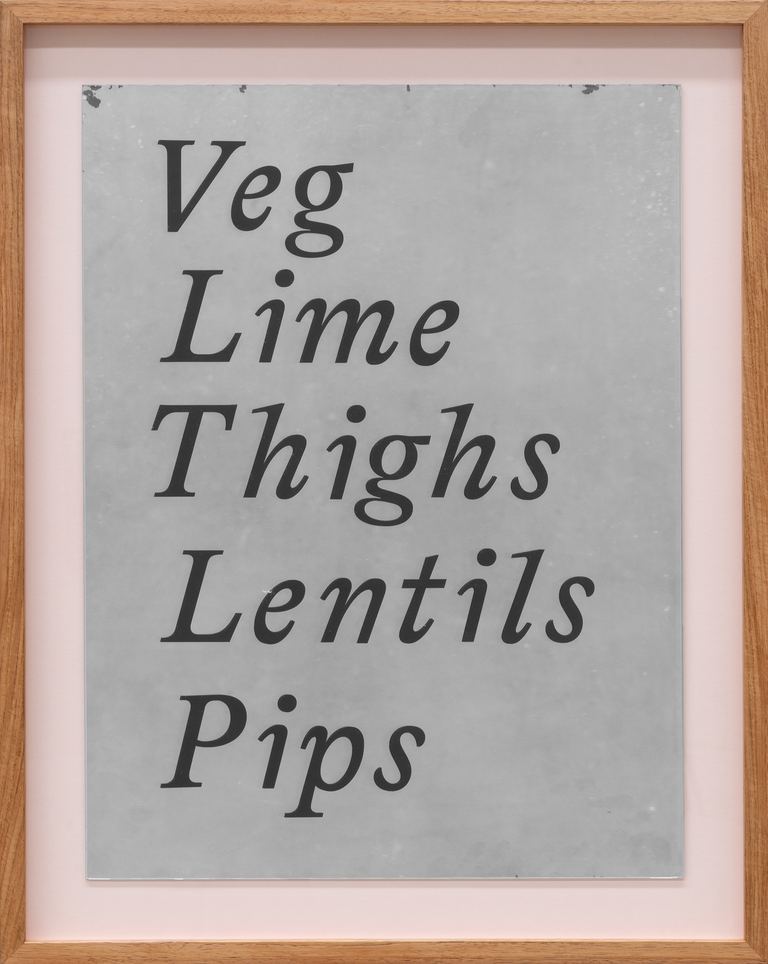
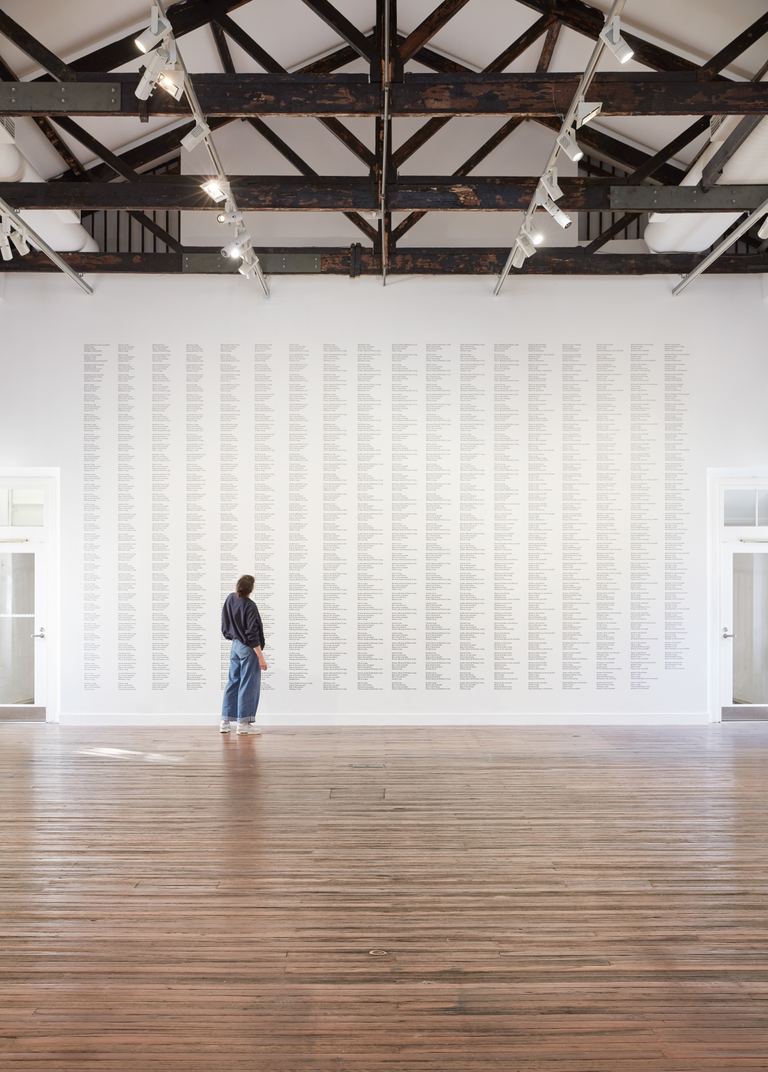
Drawing attention to the shifting properties and relations of ground and figure, surface and inscription, part and whole, Cairns explores language as resource, image, and presence at the level of letter and word, signifier and signified, often focusing on quotidian ingredients. A shopping list rendered in lineated vinyl script on mirror—‘Veg Lime Thighs Lentils Pips’—is reframed as a minimalist concrete mnemonic, mimetic of the provisioning of domestic life. Suggesting a dish to be made and eaten at home, a synecdoche of compositional process, the selection of items is connotatively rich. At the other extreme, Polaroid Sketch (2021–2) takes the form of a 10,000-word poem in columns occupying an entire wall, only partly readable in situ. The force of this expansive, recombinant text lies in its immensity, as it rings the changes on a series of short, phrasal elements . . .
Pennie & Goldie in bag
Bag in the kitchen
Box on the verandah
Patch in box
Pennie & Goldie in box
Box on the verandah
Bag in the kitchen
Patch in bag
… to produce a conceptual–linguistic score mapping seriality, repetition, variation, position, and scale. Words operate as signs, placeholders, code switchers, names, and objects shuffled as integers of ‘in’ and ‘on’, nesting, opening and closing, boxing and unboxing. Polaroid Sketch explores the shifting syntax of processual metonymic exchange and threshold spaces, scrolling down and across the surface of the wall, block by block, stanzaic succession advancing in stop-motion bites.
The programmatic largesse of Polaroid Sketch is inverted in the containment of Cairns’s bronze plaques, where the ratio of nearness and distance, motion and stillness, is built into the barely legible pictographic marks and impressions. Alluding to the sculptural inscriptions of Ian Hamilton Finlay, these instant relics confer armorial and (im)memorial monumentality on nostalgic Rousseauian salvage (words for colours, advertising copy for men’s grooming).
A languaged body-in-pieces is assembled, disassembled, and reassembled across a set of paintings. The authorial subject-in-language is conjured as a shapeshifting conduit: a body composed of sharpened pencils in Author (2018), a tongue in a flame-lit oral cavity in Artist’s Mouth (2019), a hand plucking a lyre in Erato (2025). Soliloquy Workshop (2018) stages the prosthetic conflation of artistic handiwork and the tools of the trade in an encounter between a pencil figure caught drawing and fleshy fingers that hold a torch and point. Creative capacity figures as systemic and idiolectal: polyvalent, reversible, enigmatic, and erotically charged. Even where no language as such is pictured, Cairns’s titles provide integral annotations, insisting on the fundamental role of poesis in aesthesis. First Names (2018) playfully explodes ‘Mitch’ as decentred mirror writing. WHAT WA(s) THE NATURE OF WHAT WAS SAID? ?YRROS APOLOGETIC? ?NIA(g)A YAS COULD YOU PLEASE ADDRESS THE QUESTION DIRECTLY? (2015) suggests jammed transcription: an interrogatory, asemic thicket. Dislocated E or A Vowel (2025) depicts the anthropomorphic glee of the floating signifier as an outsize letter E on the move.
A gentle vein of good humour runs through Cairns’s work, from sight gags to broad comedy to delicate whimsy. Papers (2007–13), a series of laconic texts screen-printed on paper incorporating words in ‘booby’ font—drawn in conjugal collaboration with Agatha Gothe-Snape—narrates a creative cut: ‘Update nothing & exit everything,’ ‘all practice is discontinued’. It unfolds as a jokey ‘ageless coupling’ in which big-breasted words infiltrate the indicatively male, monastic atelier with its laboriously described blank drywall and ‘small SINGLE sized bed and kitchenette’. The pattern of enlarged, ‘boobed’ words—‘accent’, ‘instance’, ‘single’, ‘books’, ‘inward’, ‘bar’, ‘almost’, ‘ETC’—gives rise to an off-the-cuff, vaudevillian ‘Pap’ and ‘Mam’ ‘chorus’, a promise of future partnership (‘ETC’). The Reader’s Voice (2015) presents the reader as artist in a set of thirty-four French-inflected Letraset collages. Paying homage to the graphic joie de vivre of the Parisian lettristes, these collages incorporate drawings and photographs converted into stickers combined with Letraset words and symbols. The reader/viewer is invited into this vibrant, delicately layered collection as a gesture of hospitality that nonetheless remains discreet, allowing us to experience the formal beauty of its composition while protecting its private meanings and associations. This sense of a shared understanding of the irreducible singularity and intimacy of ‘Lives and Works’ (the title of another painting) is at the heart of Cairns’s serious play and his commitment to the affecting interanimation of the verbal and the visual, the material and the conceptual, the elevated and the rough and ready. A rose submerged in a vase, the repeated motif of an emergency notice, the slide from ‘tome’ to ‘tomb’, hint at the domain of the unconscious and its im/perfect accessibility; the fortuity of language and image as intermediaries and their inexhaustible rapport.
Kate Lilley is Poet-scholar at large; Honorary Associate Professor, University of Sydney